Choosing a Laser Level for Layout and Leveling Work
Last reviewed October 31, 2026. Prices were listed by the retailer as of Oct 30, 2026 and can change. Confirm the current price and availability on the retailer's page before you buy.
Layout work asks a tool to hold a straight, true reference across a space where nothing else is straight or true. A floor may slope, a wall may lean, and a ceiling grid has to line up with a chalk mark you snapped an hour ago. The tool has to stay accurate while it is bumped, moved, set on a tripod or clamped to a pole, and while the person using it is distracted by the actual building task. That is what makes this category hard: the job punishes small errors that grow over distance, and the tool does not announce when it has drifted.
Four decisions drive the choice, and they match the specifications worth reading in a listing. First, line or dot: a line projects a visible stripe across a surface, which suits aligning tile, cabinets or framing, while a dot marks a single point, which suits transferring a position from floor to ceiling. Second, range, meaning how far the beam is stated to reach, which matters more in large rooms and on open sites than in a single bedroom. Third, self-leveling, which in general means the unit settles itself to level within a limited tilt so you do not have to adjust it by eye. Fourth, the power source, whether batteries, a rechargeable pack or a cord, since that decides what else you must own or buy.
The catalog shows how wide the field is. Milwaukee accounts for 39 of the listings, followed by DeWalt with 11, Bosch with 8, Hilti with 4, Crescent with 3 and Makita with 2. Configuration is often unclear: 46 listings do not state one, 12 are listed as a bare tool and 10 as a kit. Only 16 of the 68 are cordless models. Because so many listings leave details out, reading what each one actually states is the most useful habit you can build.
How to choose
Line or dot
A line projection draws a visible stripe on a wall or floor, which is handy when you need to align many items along one reference. A dot marks a single point, which is better for carrying a position vertically. Check the listing text to see which pattern the tool projects, and do not assume. Some listings say little, so confirm before buying.
Stated range
Range is the distance the beam is stated to reach. Rotary tools in this category are often listed with long ranges, such as the 800 ft. in one kit title, while small room tools are meant for shorter spans. Match the stated range to your largest typical workspace, and remember a listing figure describes the tool, not your site conditions.
Self-leveling
Self-leveling means the tool adjusts itself to level inside a limited tilt, so you place it and get a reference without fine tuning by eye. A listing that states self-leveling saves setup time on repeated layout. If a listing does not mention it, treat the feature as unconfirmed rather than assumed.
Power source
Check whether the tool runs on batteries, a rechargeable pack or something else, and whether those are included. A bare tool is the tool only, with no battery or charger. Only 16 of the 68 listed models are cordless, so power is worth confirming in each listing before you commit to a purchase.
Configuration and contents
Kits can include extras such as a carrying case, and one listing here states a case or bag. The tool-only versions cost less but leave you to source accessories. Since 46 listings do not state a configuration, look at the in-the-box line and, where it is missing, treat contents as unknown.
Price against your use
A higher price can reflect a larger kit or a longer-range tool, but the listings do not tell you which, so compare stated specs side by side. Buy for the work you actually do, not for the largest number on the page.
Our picks from the catalog
These picks come from what the listings state: prices, specifications and kit contents. Each says which listed facts it is based on.
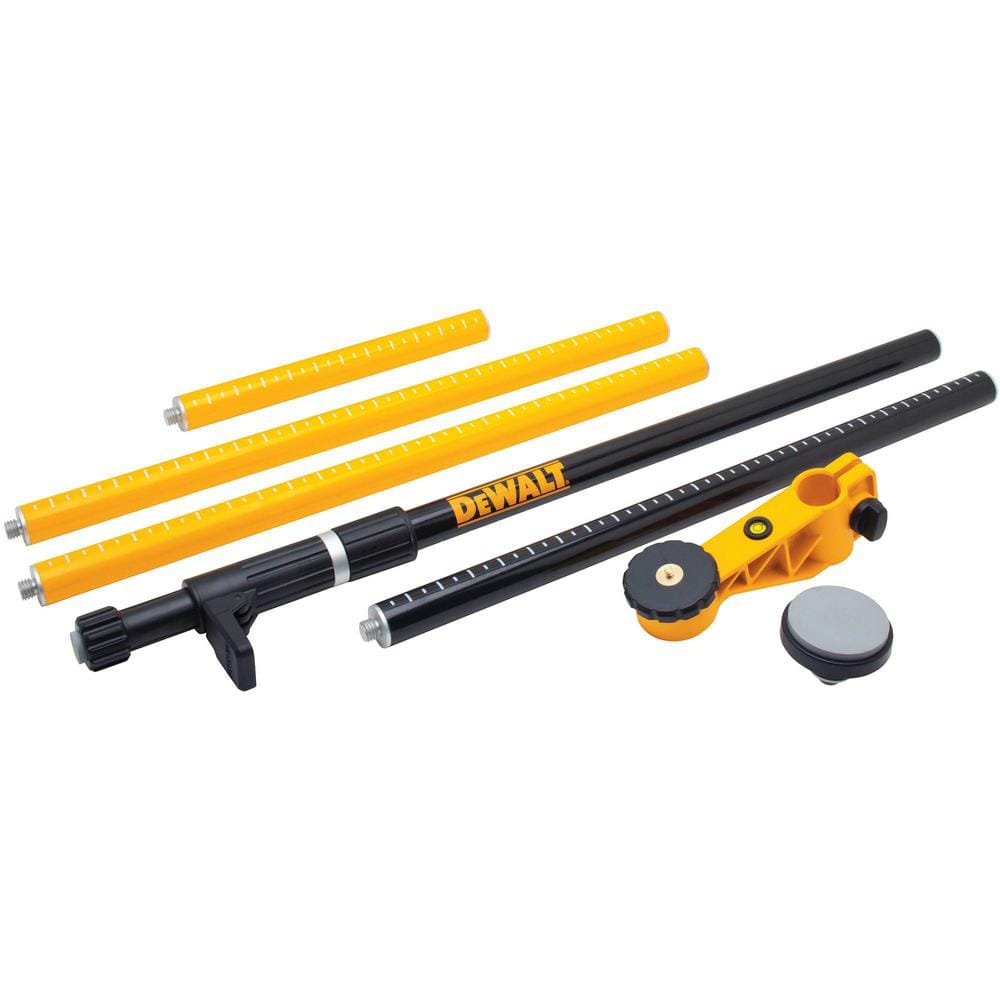
DeWalt Laser Level Mounting Pole with 1/4 in. Base
$200.99 · Size / capacity: 1/4 in.
This is the lowest-priced model, at $200.99, among the 14 whose listings state at least one specification. It is a DeWalt laser level mounting pole, model DW0882, with a stated 1/4 in. base size. Keep in mind that the listing does not state a configuration and says nothing about the beam itself. It appears to be a mounting accessory rather than a laser, so confirm what you are getting and whether you still need a separate level.

Bosch 800 ft. Rotary Laser Level Complete Kit Self Leveling with Hard Carrying Case
$719 to $1,199 · Kit
This pick rests on having the most complete kit contents stated among the listings: the listing states a case or bag. It is the Bosch GRL 800-20 HVK, titled as an 800 ft. rotary laser level complete kit, self-leveling, with a hard carrying case. The listed price runs from $719 to $1,199. Keep in mind that the specs field is empty in the data, so confirm battery and charger details in the listing, since only the case is stated as included.
Skip it if...
- Skip the DeWalt mounting pole if you need a tool that projects its own beam, since the listing only states a 1/4 in. base size and no laser details.
- Skip the Bosch rotary kit if your work stays within one small room, because its 800 ft. title and $719 to $1,199 price point toward larger spaces.
- Skip any listing that leaves configuration unstated if you need a battery or charger in the box, because 46 of the 68 models do not say.
- Skip a bare tool listing if you do not already own a compatible power source, since a bare tool is listed as the tool only.
Buying checklist
- Decide whether you need a line or a dot projection.
- Compare the stated range with your largest workspace.
- Confirm the listing states self-leveling.
- Check the power source and whether a battery is included.
- Read the in-the-box line before assuming a case or charger.
- Confirm the model number matches the product you intend to buy.
Frequently asked questions
How many laser level and measuring models are listed?
The catalog lists 68 models in this category. Milwaukee has the most with 39, followed by DeWalt with 11, Bosch with 8, Hilti with 4, Crescent with 3 and Makita with 2. All 68 are typed as level or laser tools.
What is the price range?
That means half the models sit below roughly $396 and half above. Some listings show a price span instead of one figure, such as $719 to $1,199 for one Bosch kit.
What does a bare tool mean here?
A bare tool is listed as the tool only, with no battery or charger. In this category, 12 listings are bare tools, 10 are kits and 46 do not state a configuration. If the listing does not say a battery is included, do not assume it is.
How many of these are cordless?
The catalog shows 16 cordless models out of 68. The data does not list a battery platform for these tools, so check each listing for how the tool is powered and whether any battery is included before you decide.
Does the budget pick include a laser?
The budget pick is a DeWalt laser level mounting pole, model DW0882, listed at $200.99 with a 1/4 in. base. Its listing does not state a configuration or any beam details, so it appears to be a mounting accessory. Confirm that before expecting it to project a line or dot.